No results found
At Alison Sullivan and Associates we see people as more than just their thoughts, behavior patterns or a set of physical symptoms.
At Alison Sullivan and Associates we see people as more than just their thoughts, behavior patterns or a set of physical symptoms.
A 4-Session Series for Nervous System Regulation, Deep Rest, and Emotional Healing
Experience deep, restorative rest in a trauma-informed Yoga Nidra workshop in Fredericksburg, VA, designed to support nervous system regulation, emotional resilience, and embodied safety. This four-session, in-person Yoga Nidra series offers a gentle, therapeutic approach to rest and healing for individuals experiencing stress, anxiety, burnout, or trauma-related symptoms.
Yoga Nidra—often referred to as yogic sleep—is a guided meditation practice that allows the body to enter a deeply restorative state while maintaining conscious awareness. This workshop is especially beneficial for those who struggle to relax, feel chronically “on edge,” or want a safe, accessible way to calm the nervous system without physical exertion.
All sessions are held in person at 2619 Princess Anne St, Unit A, Fredericksburg, VA 22401.
This workshop will start 2/23 and go through 3/16, and be held on Mondays from 7-8pm.
Pricing for this workshop is broken down into three tier options that you have the option of selecting one tier to participate int he workshop.
Support: for those needing financial flexibility - $85
Sustain: for those able to meet their own needs comfortably - $99
Share: for those who can support themselves and help make this workshop accessible to others - $115
Are you longing for deep rest, steadiness, and a sense of safety in your body, especially during times of stress, transition, or burnout? This four-session, in-person Yoga Nidra workshop offers a gentle, trauma-informed space to slow down, reconnect, and allow your nervous system to restore itself naturally.
Yoga Nidra is a guided, meditative practice done lying down or seated comfortably. Often called “yogic sleep,” it supports deep rest without effort, helping the body release chronic tension while the mind remains softly aware. This series is especially supportive for those experiencing anxiety, overwhelm, fatigue, or a persistent sense of being “on edge.”
Each weekly session builds upon the last, creating a predictable and supportive rhythm while gently guiding you toward greater internal safety, autonomy, and integration.
Session 1: Grounding and Safety
Focus: Establishing internal safety and predictability
Nervous System Target: Parasympathetic activation
We begin by creating a sense of safety in the body and mind, introducing Yoga Nidra as a reliable internal refuge.
Session 2: Letting the Body Rest
Focus: Releasing effort, fatigue, and vigilance
Nervous System Target: Down-regulating chronic hyperarousal
This session supports deep rest, allowing the nervous system to release long-held patterns of tension and alertness.
Session 3: Reclaiming Choice and Agency
Focus: Restoring a sense of autonomy and inner authority
Nervous System Target: Vagal tone and self-efficacy
Participants are gently guided toward reconnecting with choice, boundaries, and internal leadership.
Session 4: Integration and Gentle Forward Movement
Focus: Carrying rest and awareness into daily life
Nervous System Target: Integration of regulation with action
We close by exploring how to bring the felt sense of rest and regulation into everyday moments and transitions.
Feel chronically stressed, anxious, or emotionally exhausted
Have difficulty fully resting or “turning off” your mind
Are healing from trauma and want a gentle, body-based approach
Want to deepen your connection to your body in a safe, supported way
Are curious about Yoga Nidra but want trauma-informed guidance
No yoga experience is required. All practices are invitational and adaptable.
Four in-person, guided Yoga Nidra sessions
Trauma-informed, nervous-system-focused instruction
A small, supportive group environment
Practices you can return to outside of sessions
2619 Princess Anne St, Unit A
Fredericksburg, VA 22401
This workshop will start 2/23 and go through 3/16, and be held on Mondays from 7-8pm.
Camille LoRocco, MSW
Camille is a trauma-informed clinician who integrates nervous system education, embodied awareness, and gentle somatic practices into her work. Her approach emphasizes safety, choice, and respect for each participant’s unique pace and lived experience.
Pricing for this workshop is broken down into three tier options that you have the option of selecting one tier to participate int he workshop.
Tier 1: Support for those needing financial flexibility - $85
Tier 2: Sustain for those able to meet their own needs comfortably - $99
Tier 3: Share for those who can support themselves and help make this workshop accessible to others - $115
There are only 12 spots available for this workshop. Grab your spot today!
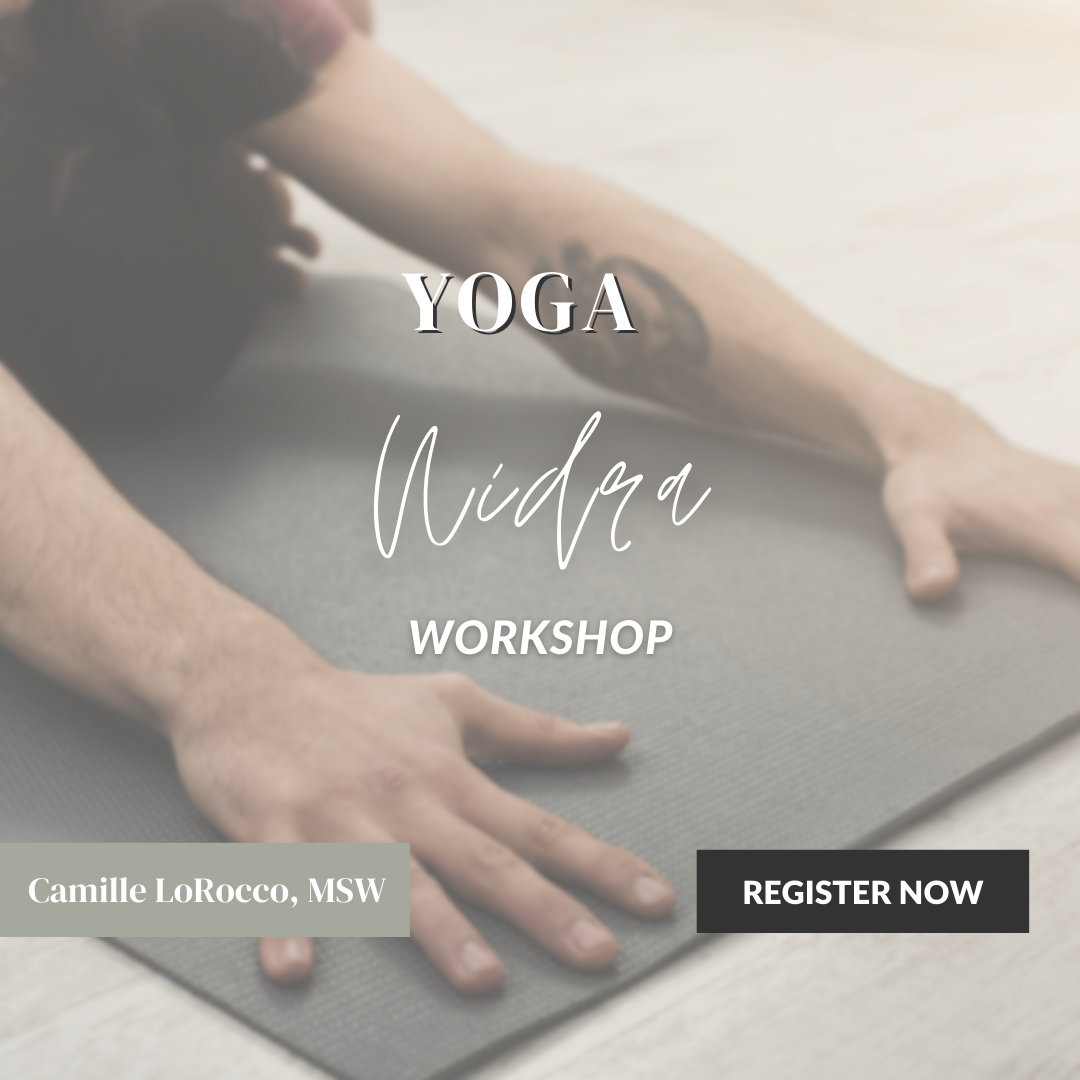
This Fredericksburg Yoga Nidra workshop is well-suited for:
Individuals experiencing anxiety, overwhelm, or burnout
People recovering from trauma or chronic stress
Those seeking trauma-informed yoga or somatic therapy alternatives
Highly sensitive individuals or nervous system-aware practitioners
Anyone wanting deep rest without physical strain
** No yoga or meditation experience is required. All practices are invitational and adaptable.
Are you longing for deep rest, steadiness, and a sense of safety in your body, especially during times of stress, transition, or burnout? This four-session, in-person Yoga Nidra workshop offers a gentle, trauma-informed space to slow down, reconnect, and allow your nervous system to restore itself naturally.
Yoga Nidra is a guided, meditative practice done lying down or seated comfortably. Often called “yogic sleep,” it supports deep rest without effort, helping the body release chronic tension while the mind remains softly aware. This series is especially supportive for those experiencing anxiety, overwhelm, fatigue, or a persistent sense of being “on edge.”
Each weekly session builds upon the last, creating a predictable and supportive rhythm while gently guiding you toward greater internal safety, autonomy, and integration.
Session 1: Grounding and Safety
Focus: Establishing internal safety and predictability
Nervous System Target: Parasympathetic activation
We begin by creating a sense of safety in the body and mind, introducing Yoga Nidra as a reliable internal refuge.
Session 2: Letting the Body Rest
Focus: Releasing effort, fatigue, and vigilance
Nervous System Target: Down-regulating chronic hyperarousal
This session supports deep rest, allowing the nervous system to release long-held patterns of tension and alertness.
Session 3: Reclaiming Choice and Agency
Focus: Restoring a sense of autonomy and inner authority
Nervous System Target: Vagal tone and self-efficacy
Participants are gently guided toward reconnecting with choice, boundaries, and internal leadership.
Session 4: Integration and Gentle Forward Movement
Focus: Carrying rest and awareness into daily life
Nervous System Target: Integration of regulation with action
We close by exploring how to bring the felt sense of rest and regulation into everyday moments and transitions.
Feel chronically stressed, anxious, or emotionally exhausted
Have difficulty fully resting or “turning off” your mind
Are healing from trauma and want a gentle, body-based approach
Want to deepen your connection to your body in a safe, supported way
Are curious about Yoga Nidra but want trauma-informed guidance
No yoga experience is required. All practices are invitational and adaptable.
Four in-person, guided Yoga Nidra sessions
Trauma-informed, nervous-system-focused instruction
A small, supportive group environment
Practices you can return to outside of sessions
2619 Princess Anne St, Unit A
Fredericksburg, VA 22401
This workshop will start 2/23 and go through 3/16, and be held on Mondays from 7-8pm.
Camille LoRocco, MSW
Camille is a trauma-informed clinician who integrates nervous system education, embodied awareness, and gentle somatic practices into her work. Her approach emphasizes safety, choice, and respect for each participant’s unique pace and lived experience.
Pricing for this workshop is broken down into three tier options that you have the option of selecting one tier to participate int he workshop.
Tier 1: Support for those needing financial flexibility - $85
Tier 2: Sustain for those able to meet their own needs comfortably - $99
Tier 3: Share for those who can support themselves and help make this workshop accessible to others - $115
There are only 12 spots available for this workshop. Grab your spot today!
Each session in this Yoga Nidra therapy-informed workshop builds on the last, creating a sense of continuity and trust while supporting long-term nervous system regulation.
Focus: Establishing internal safety and predictability
Nervous System Target: Parasympathetic activation
Participants are guided toward a felt sense of safety and stability, laying the foundation for deep rest.
Focus: Releasing chronic tension, fatigue, and hypervigilance
Nervous System Target: Down-regulating chronic stress responses
This session supports physical and emotional restoration through sustained rest.
Focus: Restoring autonomy and inner authority
Nervous System Target: Vagal tone and self-efficacy
Participants reconnect with their capacity for choice, boundaries, and self-direction.
Focus: Applying nervous system regulation to daily life
Nervous System Target: Integration of regulation with action
The final session supports carrying calm, awareness, and self-trust into everyday experiences.
Are you ready to deepen your self-awareness and bring more peace and creativity into your daily life?
Are you longing for deep rest, steadiness, and a sense of safety in your body, especially during times of stress, transition, or burnout? This four-session, in-person Yoga Nidra workshop offers a gentle, trauma-informed space to slow down, reconnect, and allow your nervous system to restore itself naturally.
Yoga Nidra is a guided, meditative practice done lying down or seated comfortably. Often called “yogic sleep,” it supports deep rest without effort, helping the body release chronic tension while the mind remains softly aware. This series is especially supportive for those experiencing anxiety, overwhelm, fatigue, or a persistent sense of being “on edge.”
Each weekly session builds upon the last, creating a predictable and supportive rhythm while gently guiding you toward greater internal safety, autonomy, and integration.
Session 1: Grounding and Safety
Focus: Establishing internal safety and predictability
Nervous System Target: Parasympathetic activation
We begin by creating a sense of safety in the body and mind, introducing Yoga Nidra as a reliable internal refuge.
Session 2: Letting the Body Rest
Focus: Releasing effort, fatigue, and vigilance
Nervous System Target: Down-regulating chronic hyperarousal
This session supports deep rest, allowing the nervous system to release long-held patterns of tension and alertness.
Session 3: Reclaiming Choice and Agency
Focus: Restoring a sense of autonomy and inner authority
Nervous System Target: Vagal tone and self-efficacy
Participants are gently guided toward reconnecting with choice, boundaries, and internal leadership.
Session 4: Integration and Gentle Forward Movement
Focus: Carrying rest and awareness into daily life
Nervous System Target: Integration of regulation with action
We close by exploring how to bring the felt sense of rest and regulation into everyday moments and transitions.
Feel chronically stressed, anxious, or emotionally exhausted
Have difficulty fully resting or “turning off” your mind
Are healing from trauma and want a gentle, body-based approach
Want to deepen your connection to your body in a safe, supported way
Are curious about Yoga Nidra but want trauma-informed guidance
No yoga experience is required. All practices are invitational and adaptable.
Four in-person, guided Yoga Nidra sessions
Trauma-informed, nervous-system-focused instruction
A small, supportive group environment
Practices you can return to outside of sessions
2619 Princess Anne St, Unit A
Fredericksburg, VA 22401
This workshop will start 2/23 and go through 3/16, and be held on Mondays from 7-8pm.
Camille LoRocco, MSW
Camille is a trauma-informed clinician who integrates nervous system education, embodied awareness, and gentle somatic practices into her work. Her approach emphasizes safety, choice, and respect for each participant’s unique pace and lived experience.
Pricing for this workshop is broken down into three tier options that you have the option of selecting one tier to participate int he workshop.
Tier 1: Support for those needing financial flexibility - $85
Tier 2: Sustain for those able to meet their own needs comfortably - $99
Tier 3: Share for those who can support themselves and help make this workshop accessible to others - $115
There are only 12 spots available for this workshop. Grab your spot today!
Yoga Nidra is a meditation-based nervous system regulation practice that activates the parasympathetic nervous system, supporting rest, recovery, and emotional processing. Unlike traditional yoga classes, Yoga Nidra is practiced lying down or seated comfortably and requires no physical movement.
This trauma-informed Yoga Nidra workshop emphasizes:
Safety and predictability
Choice and autonomy
Gentle awareness of the body
Nervous system education and integration
Yoga Nidra, most commonly thought of as a deeply restful, guided meditation, allows the body
and mind to enter a state between wakefulness and sleep. In this deeply relaxed state,
the parasympathetic nervous system becomes dominant.
Yoga Nidra helps counteract chronic stress, trauma responses, and anxiety.
It supports physiological calming, reducing heart rate, blood pressure, and cortisol levels.
The practice of Yoga Nidra helps access a grounded, regulated state that increases receptivity to therapeutic work.
Unlike traditional relaxation, Yoga Nidra leads practitioners through systematic awareness of
the body and breath, often incorporating visualization and intention-setting (Sankalpa).
This creates a bridge between conscious and unconscious processes, allowing clients to safely explore emotional material that may be difficult to access in other ways.
It supports trauma integration by fostering nonverbal processing, which is a crucial complement to cognitive approaches.
For trauma survivors, Yoga Nidra provides a non-invasive somatic entry point for healing.
It allows clients to experience body awareness without triggering the hypervigilance that can arise in more active practices.
Studies show that body-based mindfulness practices help re-establish a sense of safety in the body, which is essential for trauma recovery.
It aligns well with Internal Family Systems (IFS) and trauma-informed frameworks, where inner parts can be noticed compassionately without judgment.
Yoga Nidra helps address common symptoms like insomnia, depression, and anxiety by
teaching the body how to enter deep rest.
Regular practice improves sleep quality and reduces rumination, promoting mood stabilization.
It enhances interoceptive awareness, allowing one to notice and manage emotional and physical cues of distress.
Psychotherapy often focuses on cognitive and emotional processing, while Yoga Nidra
supports somatic integration, helping align cognitive mental insights with body-based calm.
This balance strengthens self-awareness, reduces dissociation, and cultivates a felt sense of safety and wholeness.
Yoga Nidra provides an embodied practice that can be used independently between sessions.
Yoga Nidra requires no movement and can be practiced lying down or seated, making it
accessible for ALL.
Are you longing for deep rest, steadiness, and a sense of safety in your body, especially during times of stress, transition, or burnout? This four-session, in-person Yoga Nidra workshop offers a gentle, trauma-informed space to slow down, reconnect, and allow your nervous system to restore itself naturally.
Yoga Nidra is a guided, meditative practice done lying down or seated comfortably. Often called “yogic sleep,” it supports deep rest without effort, helping the body release chronic tension while the mind remains softly aware. This series is especially supportive for those experiencing anxiety, overwhelm, fatigue, or a persistent sense of being “on edge.”
Each weekly session builds upon the last, creating a predictable and supportive rhythm while gently guiding you toward greater internal safety, autonomy, and integration.
Session 1: Grounding and Safety
Focus: Establishing internal safety and predictability
Nervous System Target: Parasympathetic activation
We begin by creating a sense of safety in the body and mind, introducing Yoga Nidra as a reliable internal refuge.
Session 2: Letting the Body Rest
Focus: Releasing effort, fatigue, and vigilance
Nervous System Target: Down-regulating chronic hyperarousal
This session supports deep rest, allowing the nervous system to release long-held patterns of tension and alertness.
Session 3: Reclaiming Choice and Agency
Focus: Restoring a sense of autonomy and inner authority
Nervous System Target: Vagal tone and self-efficacy
Participants are gently guided toward reconnecting with choice, boundaries, and internal leadership.
Session 4: Integration and Gentle Forward Movement
Focus: Carrying rest and awareness into daily life
Nervous System Target: Integration of regulation with action
We close by exploring how to bring the felt sense of rest and regulation into everyday moments and transitions.
Feel chronically stressed, anxious, or emotionally exhausted
Have difficulty fully resting or “turning off” your mind
Are healing from trauma and want a gentle, body-based approach
Want to deepen your connection to your body in a safe, supported way
Are curious about Yoga Nidra but want trauma-informed guidance
No yoga experience is required. All practices are invitational and adaptable.
Four in-person, guided Yoga Nidra sessions
Trauma-informed, nervous-system-focused instruction
A small, supportive group environment
Practices you can return to outside of sessions
2619 Princess Anne St, Unit A
Fredericksburg, VA 22401
This workshop will start 2/23 and go through 3/16, and be held on Mondays from 7-8pm.
Camille LoRocco, MSW
Camille is a trauma-informed clinician who integrates nervous system education, embodied awareness, and gentle somatic practices into her work. Her approach emphasizes safety, choice, and respect for each participant’s unique pace and lived experience.
Pricing for this workshop is broken down into three tier options that you have the option of selecting one tier to participate int he workshop.
Tier 1: Support for those needing financial flexibility - $85
Tier 2: Sustain for those able to meet their own needs comfortably - $99
Tier 3: Share for those who can support themselves and help make this workshop accessible to others - $115
There are only 12 spots available for this workshop. Grab your spot today!
This workshop is led by Camille LoRocco, MSW, a trauma-informed clinician who integrates nervous system science, somatic awareness, and gentle therapeutic practices. Camille’s approach prioritizes emotional safety, consent, and respect for each participant’s lived experience.
This series is not a fitness-based yoga class, but a therapeutic, nervous-system-focused Yoga Nidra experience aligned with modern trauma treatment principles.